


Note: a version of this originally appeared in the March/April 2026 issue of Skeptical Inquirer magazine.
Public opinion driven by fear has immense influence in our society, especially when it comes to science and health topics.
A poorly conducted study becomes a clickbait media article that misrepresents the data, the study’s flaws, and the real-world implications, and it goes viral when other outlets pick it up. The claims circulate among the public and eventually become cultural belief. When those beliefs are repeated enough, they shape consumer behavior, corporate decisions, and medical practice—even as scientists and skeptics try to correct the record.
The paraben story is a case study in how the irrational fear of chemicals undermines science and public health. What began as public outcry after media outlets amplified a terribly done study vilified a misunderstood and incredibly safe class of preservatives.
Parabens are among the safest, most studied preservatives in modern consumer and medical products, yet ask a random group of people and they’ll tell you they’re toxic, causing “endocrine disruption” and cancer. They don’t.
The science has been consistent for decades, but misinformation is winning the discourse war. The result? Public harm. Not hypothetical dangers, but real-world consequences: unfounded fears of safe substances, contaminated consumer products, preventable skin and eye infections, increased allergic reactions, and distrust of scientific experts.
Science Misinformation Spreads Faster Than Nuanced Reality
Nearly all anti-science rhetoric follows the same pattern: a weak or poorly interpreted study is mischaracterized by someone without the training to evaluate the data. That distortion is then amplified by media outlets, influencers, celebrities, and/or politicians, and suddenly a fringe claim carries mainstream legitimacy.
Misinformation spreads faster than correction in part because only 28 percent of Americans have civic science literacy—the ability to find, understand, and apply scientific information to decisions about health and policy. That gap exists among our lawmakers too, which helps explain why laws and regulations often diverge from the body of evidence.
One of the most powerful drivers of science misinformation is chemophobia, which is baked into our cultural narrative and crosses ideological lines. Chemophobia is the reflexive fear of “chemicals,” especially synthetic ones, regardless of dose, exposure, or evidence of harm. It thrives on the idea that natural equals safe and chemical equals dangerous—a belief system that fuels everything from vaccine fear to food panic to the booming “clean beauty” industry (Love 2025).
Fear of parabens is a textbook example of what happens when chemophobia supersedes decades of scientific data.
Parabens Are Incredibly Safe Preservatives
I’m sure you’ve seen a skincare or beauty product with a label that says “free from parabens” or “no parabens” or something similar, right? And you may have thought: “Wait, do I need to be avoiding parabens?”
The answer is no, but you can thank social media and the misinformation landscape for the mistake. Public outcry, chemophobia, and low science literacy have created a marketplace that pressures companies to change chemical formulations because of false claims (Love 2025).
Parabens are a class of chemicals that share a naming convention, not identical behavior. They are esters of 4-hydroxybenzoic acid, and just like not all “alcohols” act the same in the body, not all parabens behave the same either.
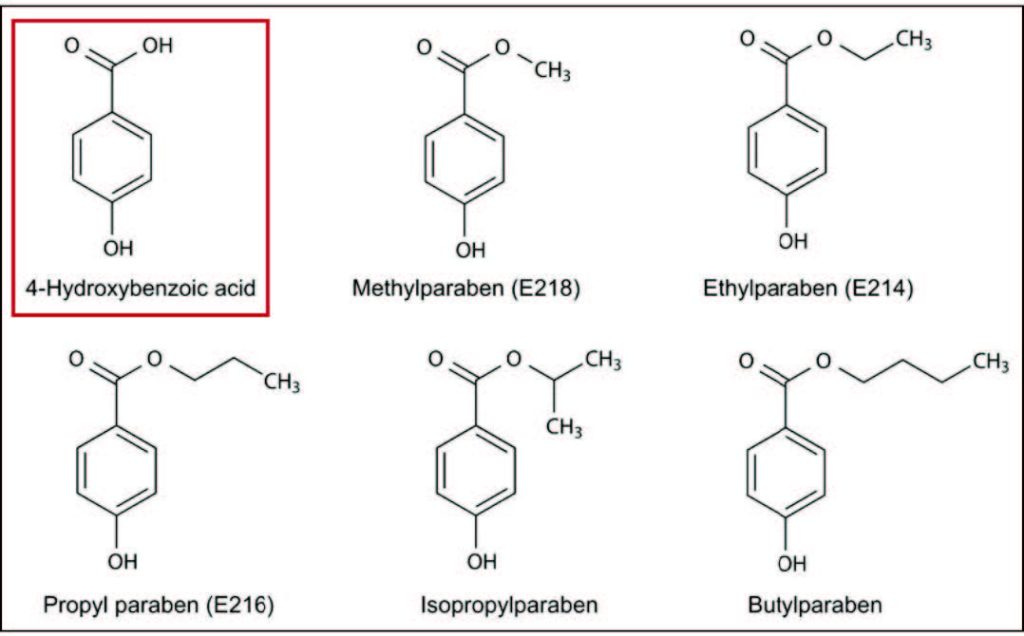
Parabens, like all preservatives, prevent harmful contamination by inhibiting the growth of bacteria, molds, and yeasts that could harm you. Parabens are very stable, low cost, and work on a broad array of microorganisms. As a result, parabens have been safely used as preservatives since the 1920s in cosmetics, skincare products, and medicines.
However, over the past several decades—and with the rise of social media—the appeal to nature fallacy and the “clean beauty” industry has painted synthetic chemicals, including parabens, as dangerous.

The ‘Study’ That Sparked the Panic
The paraben panic traces back largely to a deeply flawed 2004 paper in the Journal of Applied Toxicology—a study that should never have been published in the first place (Darbre et al. 2004).
The authors used analytical chemistry techniques to screen twenty previously frozen breast tumor samples, searching for trace amounts of parabens.
There were no healthy control tissues, no exposure histories, and no dose-response data. No biological mechanism was explored. The problems in the study design were fundamental, which is why this never should have passed peer review:
No control group equals no healthy tissue baseline: You can’t imply a cancer link without knowing what’s in healthy tissue.
No biological relevance: The authors insinuated a relationship between parabens and cancer formation, yet no biological pathway was studied.
Vanishingly small concentrations: Paraben levels reported were on the order of parts per billion, which, for context, would be equivalent to one second of time in 31.7 years.
Contamination concerns: The blank values (controls run to verify the sensitive instrumentation is operating properly) were often higher than the “measured” sample values.
This approach is like adding together rubbing alcohol (isopropanol), beer (ethanol), and antifreeze (ethylene glycol), reporting them as “total alcohols,” and then declaring that amount of alcohol is dangerous.
Yes, they’re all technically alcohols—but their effects on the body could not be more different: One can kill you in tiny amounts; one is safe on your skin but dangerous to drink; and one can be consumed in reasonable doses without risk of death.
You can’t lump multiple chemicals together and pretend they’re the same just because they are in the same broad category. That’s basic chemistry—and ignoring that is wrong and reckless.
Even if the study was well-conducted, it would have only shown detection, not causal relationship. Yet the authors made unfounded claims that fueled the resulting media headlines: bad chemicals are messing with hormones and causing cancer. Even while no scientific data supported this, public outcry followed those headlines, which fueled more misinformation, policy, product reformulation, and public harm.
The Estrogen Myth Accelerated Paraben Fears
One claim cemented the fear: that parabens are endocrine disruptors—specifically, that parabens act like estrogen and therefore interfere with normal hormone signaling.
That phrase sounds terrifying, which is exactly why it sticks. If you spend enough time online, you might be led to believe that everything is an endocrine disruptor—plastics, sunscreens, soy, receipt paper, cleaning products, candles, you name it. Some healthcare professionals buy into this, using this label as if it were a diagnosis, not an unsupported hypothesis.
In the lab, you can make almost any compound look “hormonal” if you drown cells growing on a piece of plastic with enough of it (Okubo et al 2001).
Guess what? If you pour pure water on cells in a Petri dish, they explode. That isn’t what happens when you drink water. And that means parabens don’t necessarily behave the same way in a human body as in a Petri dish either.
In cell biology, these labels don’t mean anything. What matters is legitimate biological exposure and effect. To truly be an endocrine disruptor, a substance must not only get into the body in a measurable dose but then must bind hormone receptors strongly enough and at a high enough level to trigger hormone signaling in real tissues in your body, not just in a Petri dish.
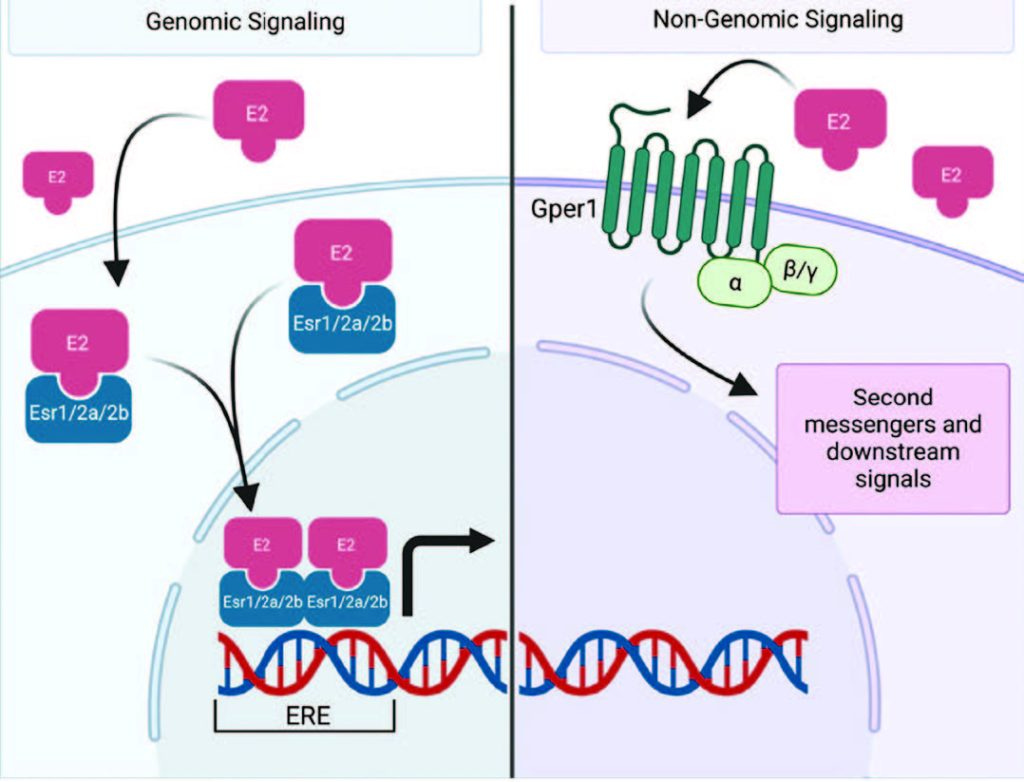
Do parabens outcompete estrogen in your body? No.
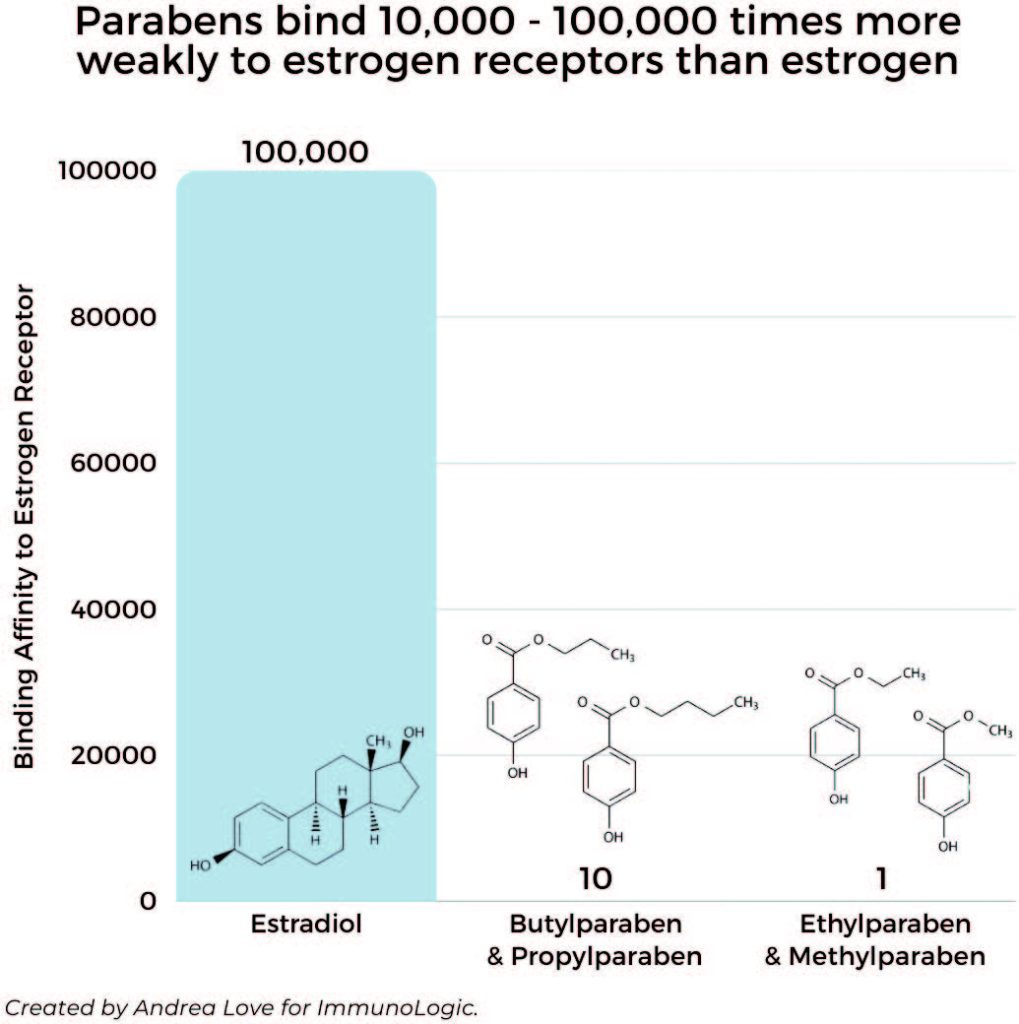
Butyl- and propylparaben bind 10,000 times more weakly than estradiol, the biologically active version of estrogen.
Methyl- and ethylparaben bind 100,000 times more weakly.
The weakness of these interactions mean there is no biological plausibility that parabens are outcompeting your hormones—even more so because your body absorbs only tiny percentages of the parabens you’re exposed to and then rapidly excretes them.
Unfortunately, once the phrases “hormone disruptor” and “synthetic chemical” enter public discourse, fear becomes almost impossible to reverse.
Harmless Parabens
More than 300 studies across toxicology, epidemiology, animal models, and clinical research have reached the same conclusion: parabens in consumer and medical products are safe (Cosmetic Ingredient Review Expert Panel 2008).
Parabens are rapidly metabolized and excreted; they do not accumulate in the body. In cosmetics, parabens are typically present at 0.01–0.3 percent. Even assuming high use of paraben-containing products, only 1–10 percent of the amount you’re exposed to is absorbed through the skin—translating to microgram-level exposure, far below any level of concern.
Animal studies reported reproductive effects at ingested doses above 1,000 mg/kg/day—100 times higher than the human acceptable daily intake (ADI) of 10 mg/kg/day—and thousands of times greater than real-world topical exposure. Even extreme, unrealistic cosmetic use doesn’t approach doses associated with harm in animal studies.
That’s why global safety authorities from the FDA to the WHO to the European SCCS consistently agree: parabens are safe when used as preservatives. But decades of data and expert consensus haven’t stopped misinformation. Even now, more than twenty years after that deeply flawed study ignited public fear, headlines continue to undermine science. You can guess what happened.
Paraben Outcry Led to Public Harm—Not Public Safety
Public pressure led companies to abandon parabens and reformulate products with alternative preservatives. This wasn’t because alternatives are superior but because companies were conceding to their customers’ false beliefs. Parabens have broad-spectrum antimicrobial activity, are stable, and are inexpensive.
The replacements? Less effective, less stable, and more expensive. For example, many companies shifted to methylisothiazolinone (MIT), a preservative with high allergenic potential (Aerts et al. 2017). As a result, a surge in contact dermatitis and skin allergies has emerged (Reeder et al. 2023; Scherrer et al. 2015; Cahill et al. 2014).
Most dangerously, microbial contamination is present in under-preserved products produced by companies that just opted out of preservatives. Preservatives are used for a reason, but the “clean, chemical-free” beauty industry has swarmed shelves with preservative-free products. Soaps, lotions, baby wipes, powders, and oils marketed as “clean” or “chemical-free” are routinely recalled for contamination with bacteria such as Pseudomonas, Staphylococcus aureus, and Burkholderia cepacia—pathogens that cause serious illness and infections, particularly in infants and immunocompromised people.
Parabens are also used in medical products—antifungal creams, corticosteroids, ophthalmic solutions, injectable medications, and some vaccines. When preservatives are weakened or removed, contamination risks rise.
Aside from the fact that almost every single person uses some skincare or cosmetic products (lotions, face wash, sunscreens, shampoo/conditioner), misinformation forced reformulation in medical products—including antifungal creams, corticosteroids, antibiotic ointments, eye drops, contact lens solutions, and injectable anesthetics.
These medical products have also faced contamination from ineffective preservation. In eye products, that means keratitis and possible blindness (U.S. Food and Drug Administration 2024; Centers for Disease Control and Prevention 2023). In injectables, it means cellulitis, sepsis, and systemic infection. Chemophobia doesn’t just change labels; it harms society.
The Real Lesson of the Paraben Panic
The paraben panic isn’t really about parabens. It’s about what happens when fear replaces evidence—when public opinion about “chemicals” overrides a century of toxicology, microbiology, and regulatory science. It’s how misinformation—accelerated by headlines, social media, and wellness influencers—reshapes markets, medical practice, and individual beliefs in ways that make us less safe, not more safe.
The snowball effect of science misinformation is a public health threat.
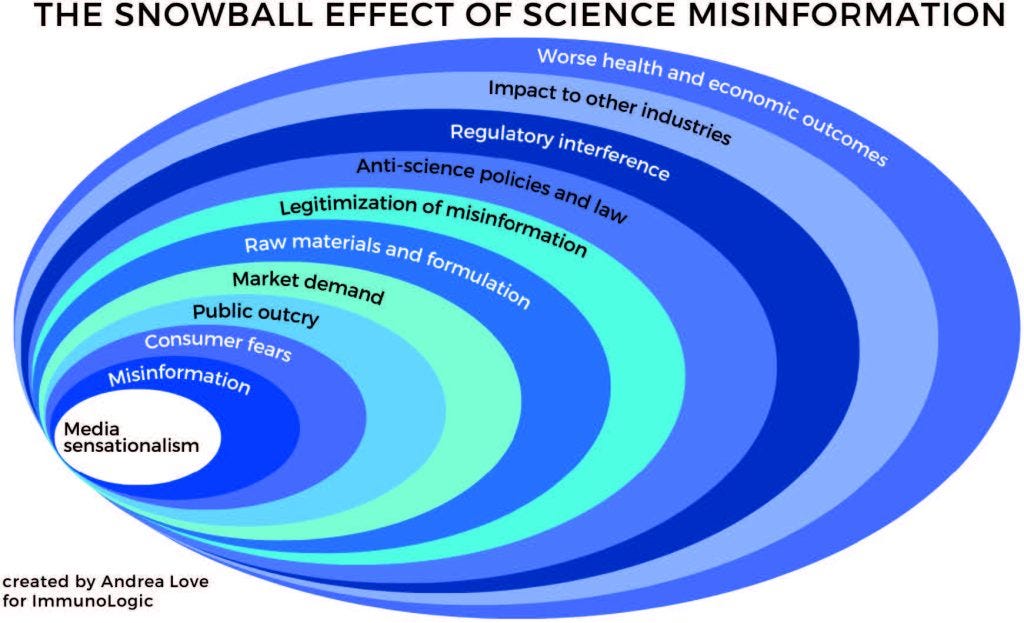
The paraben case is one example that illustrates the pattern: when falsehoods spread unchecked, they don’t just mislead; they change outcomes. “Free from parabens” products are not a win for health and safety. They show how fear beats facts—and how misinformation, once mainstreamed, becomes a driver of real-world harm.
Anti-science rhetoric, clickbait, and legislative policy that ignores evidence don’t just confuse people. They produce contaminated products, preventable infections, and unnecessary allergic reactions, eroding trust in expertise. When myths are legitimized, everyone pays the price.
We all must join in the fight for science.
Thank you for supporting evidence-based science communication. With outbreaks of preventable diseases, refusal of evidence-based medical interventions, propagation of pseudoscience by prominent public “personalities”, it’s needed now more than ever.
Stay skeptical,
Andrea
“ImmunoLogic” is written by Dr. Andrea Love, PhD - immunologist and microbiologist. She works full-time in life sciences biotech and has had a lifelong passion for closing the science literacy gap and combating pseudoscience and health misinformation as far back as her childhood. This newsletter and her science communication on her social media pages are born from that passion. Follow on Instagram, Threads, Twitter, and Facebook, or support the newsletter by subscribing below:
References
Aerts, Olivier, An Goossens, Jo Lambert, et al. 2017. Contact allergy caused by isothiazolinone derivatives: An overview of non-cosmetic and unusual cosmetic sources. European Journal of Dermatology 27: 115–122. Online at https://doi.org/10.1684/ejd.2016.2951.
Cahill, J.L., R.W. Toholka, and R.L. Nixon. 2014. Methylisothiazolinone in baby wipes: A rising star among causes of contact dermatitis. Medical Journal of Australia 200(4): 208. Online at https://doi.org/10.5694/mja13.10946.
Centers for Disease Control and Prevention. 2023. Outbreak of extensively drug-resistant Pseudomonas aeruginosa associated with artificial tears. CDC Health Alert Network (HAN) Advisory 00485 (February 1). Online at https://www.cdc.gov/han/2023/han00485.html.
Cosmetic Ingredient Review Expert Panel. 2008. Final amended report on the safety assessment of methylparaben, ethylparaben, propylparaben, isopropylparaben, butylparaben, isobutylparaben, and benzylparaben as used in cosmetic products. International Journal of Toxicology 27(Suppl. 4): 1–82.
Darbre, P.D., A. Aljarrah, W.R. Miller, et al. 2004. Concentrations of parabens in human breast tumours. Journal of Applied Toxicology 24(1): 5–13. Online at https://doi.org/10.1002/jat.958.
Golden, Robert, Jay Gandy, and Guenter Vollmer. 2005. A review of the endocrine activity of parabens and implications for potential risks to human health. Critical Reviews in Toxicology 35(5): 435–458. Online at https://doi.org/10.1080/10408440490920104.
Love, Andrea. 2025. From food dyes to vaccines: Fear of chemicals endangers us all. Skeptical Inquirer 49(6) (November/December). Online at https://skepticalinquirer.org/2025/10/from-food-dyes-to-vaccines-fear-of-chemicals-endangers-us-all/.
Okubo, T., Y. Yokoyama, K. Kano, et al. 2001. ER-dependent estrogenic activity of parabens assessed by proliferation of human breast cancer MCF-7 cells and expression of ERα and PR. Food and Chemical Toxicology 39(12): 1225–1232. Online at https://doi.org/10.1016/S0278-6915(01)00073-4.
Scherrer, M.A., V.B. Rocha, and A.R. Andrade. 2015. Contact dermatitis to methylisothiazolinone. Anais Brasileiros de Dermatologia 90(6): 912–914. Online at https://doi.org/10.1590/abd1806-4841.20153992.
Reeder, Margo J., Erin Warshaw, Srikanth Aravamuthan, et al. 2023. Methylisothiazolinone and allergic contact dermatitis. JAMA Dermatology 159(3): 267–274. Online at https://doi.org/10.1001/jamadermatol.2022.5991.
U.S. Food and Drug Administration. 2024. Alcon Laboratories issues voluntary nationwide recall of one lot of Systane Lubricant Eye Drops Ultra PF, Single Vials On-the-Go, 25 Count. Recalls, Market Withdrawals & Safety Alerts (December 21). Online at https://www.fda.gov/safety/recalls-market-withdrawals-safety-alerts/alcon-laboratories-issues-voluntary-nationwide-recall-one-1-lot-systane-lubricant-eye-drops-ultra-pf.
You have a hard job! We are flooded with so much ridiculousness that it is difficult (even for those of us who understand research methodology) to sort through the debris. I appreciate this article! I know that there are ingredients in my hair care products that I avoid because they strip the color from my hair and ingredients in skin care products that I avoid because they dry out my skin. That’s about it. This feels a lot like the “oh, my, thimerosal is toxic” argument. We are truly “dumbing down” our nation in a plethora of ways.
I would love to read your take on the “Not So Pretty” Documentary. You may have already covered this in a previous publication I haven’t come across yet. The Documentary appears to be compelling on the surface, but reeks of pseudoscience with a heavy dose of chemophobia.