


Note: a slightly different version of this was originally written for Skeptical Inquirer Magazine, for my Inside Immunity in the September/October 2026 issue.
One of the most frustrating features of the wellness industry, at least for me as an immunologist, is how readily it exploits widespread misunderstanding of the immune system and the intricate regulatory mechanisms that keep it functioning properly.
A particularly pervasive, problematic, and profitable example? Food sensitivity tests, which manufacture health anxiety by misrepresenting normal immune responses as evidence of disease. Not because there’s a problem that needs solving, but because there’s money to be made convincing people they have one.
Food “sensitivity” tests are sold direct-to-consumer and marketed as an easy and convenient way to identify foods supposedly responsible for symptoms ranging from fatigue and headaches to digestive complaints. Companies promise that a simple finger-prick blood sample can identify reactions to hundreds of foods, all from the comfort of your own home.
Sounds appealing, right? Too bad these tests don’t do what companies claim they do.
The market for at-home food sensitivity testing currently exceeds $250 million annually and is growing rapidly through aggressive marketing and promotion by wellness influencers. Yet despite its commercial success, food sensitivity testing lacks scientific support and has been repeatedly rejected by allergy and immunology organizations.
Food sensitivity tests are not evidence-based indicators of food allergies or sensitivities. Instead, they measure levels of immunoglobulin G (IgG), an antibody associated with immune memory, exposure, and tolerance.
The very antibody being marketed as evidence that your body is reacting negatively to food is actually evidence that your immune system recognizes that food as harmless.
These tests are built around a fundamental misrepresentation of immunology. Food sensitivity testing is one of the clearest examples of how legitimate scientific concepts can be stripped of context, repackaged as evidence of disease, and sold directly to consumers despite repeated warnings from allergy and immunology experts around the world.
Markers of Exposure and Immune Tolerance, Not Sensitivity
IgG antibodies against foods are generally markers of exposure and immune tolerance, not of being “sensitive.”
After exposure to food substances, IgG is a memory antibody produced as part of our immune tolerance pathway; it’s our immune system saying, “I recognize this molecule, so it doesn’t need to be attacked” (AAAAI n.d.; Aalberse et al. 2009).
Food tolerance is your body’s ability to recognize food as harmless and refrain from mounting an immune response against it, unlike the adverse immune response seen in food allergies. Dendritic cells and regulatory T cells (Tregs) in the gut-associated lymphoid tissue (GALT) work together to promote a state of “oral tolerance,” where the immune system learns to tolerate harmless food antigens encountered through diet.
This is a good thing. Otherwise, every meal you eat would trigger an inflammatory response. During this process, antibodies, such as mucosal IgA and tolerance-associated IgG, are produced, and together with regulatory T cells they help prevent the sensitization process that leads to IgE-mediated allergic reactions. IgG production and levels are more indicative of recent history or exposure than a sign of an allergy or intolerance (Stapel et al. 2008; Lavine et al. 2012). If someone has detectable IgG antibodies against a given food antigen, it simply means they’ve been repeatedly exposed to it.
There is no evidence that IgG is a reliable biomarker for food “reactivity.” These tests are marketed as detecting a problem using a biomarker that often indicates the absence of a problem. What makes the food sensitivity testing market especially concerning is that this is not a controversial or emerging area of science; allergy and immunology organizations have been rejecting food-specific IgG testing for decades.
To understand why this distinction matters, it’s helpful to understand food allergies and intolerances, neither of which are diagnosed using food-specific IgG levels.
A food allergy occurs when the body’s immune system mistakenly flags a substance in a food as harmful and mounts a rapid immune-mediated response against it. Allergic reactions are generally quick (within minutes to hours) and will occur every time the substance is encountered.
The first exposure to a food allergen leads to sensitization, where B cells of the immune system produce allergen-specific IgE antibodies that bind to mast cells. A subsequent exposure causes elicitation, where the allergen binds those IgE antibodies on mast cells and triggers mast cell degranulation.

Degranulation involves the release of inflammatory mediators stored within mast cells. These chemicals—including histamine, leukotrienes, prostaglandins, and cytokines—cause increased blood flow, tissue swelling, recruitment of immune cells, and smooth muscle contraction. Collectively, these responses produce symptoms such as hives; itching; eczema; swelling of the lips, tongue, face, or throat; gastrointestinal symptoms; respiratory symptoms; and, in severe cases, anaphylaxis.
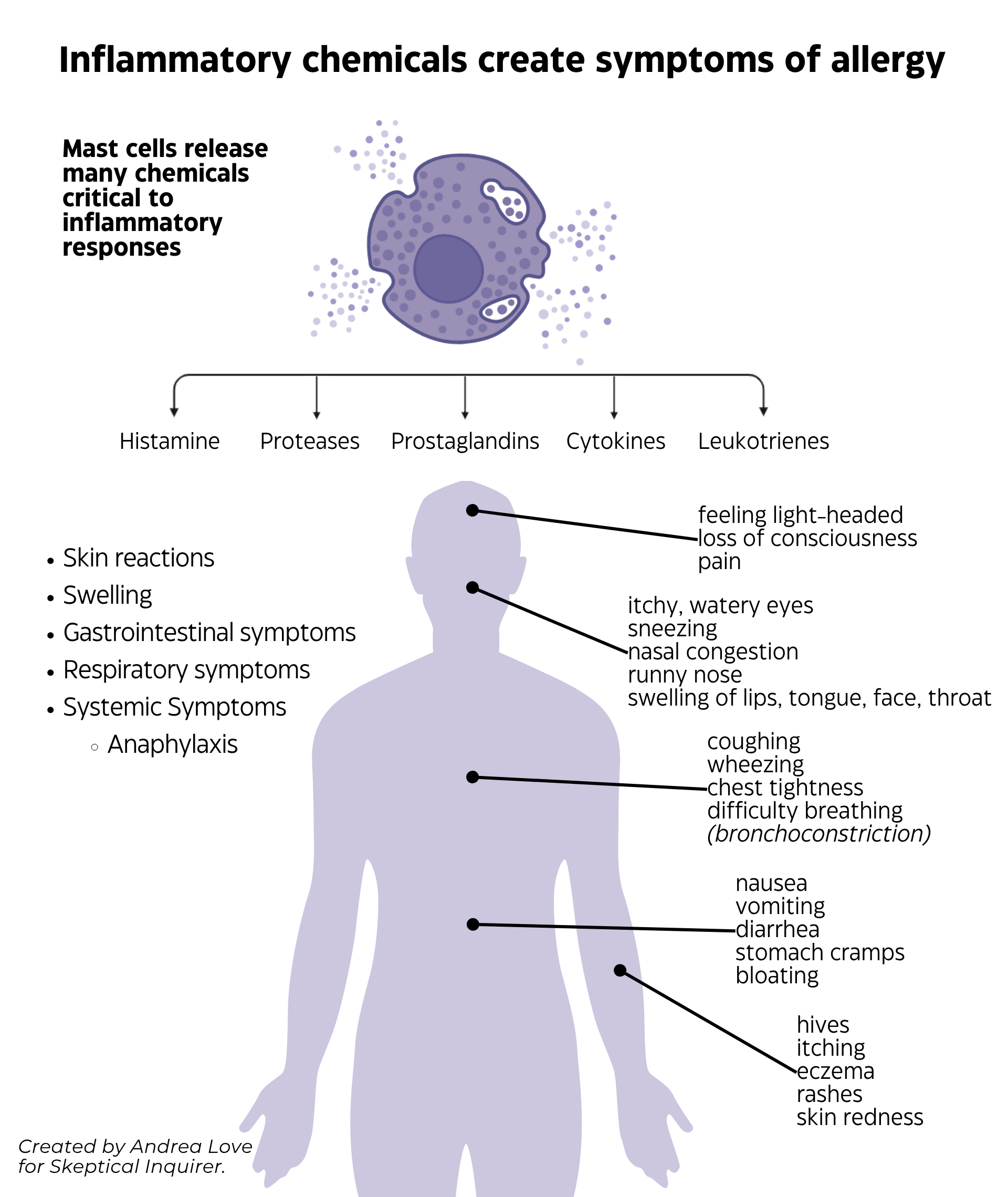
Food allergies are diagnosed by an allergist using patient history alongside skin testing, blood tests that measure allergen-specific IgE, and sometimes oral food challenges performed in a controlled clinical setting (Bird et al. 2020).
A true allergy is reliable; it will occur every time a person consumes a given food in any form. Treatment includes addressing the histamine response (by taking antihistamines and other medications), avoiding foods containing the allergen, and having epinephrine auto-injectors available in case of accidental exposure. Allergy immunotherapy is a longer-term approach that can help promote tolerance of an allergen so the individual will no longer have an inappropriate allergic reaction.
Food allergies are typically directed against specific proteins within foods, not a food as a whole. Different individuals may react to different proteins, which is why diagnosis requires clinical evaluation rather than self-testing (Loh and Tang 2018).
Food allergies affect only 2–3 percent of the population, yet up to one-quarter of adults report being “food sensitive” or intolerant (Loh and Tang 2018). This gap between diagnosed allergy and perceived food reactivity has created fertile ground for companies selling unvalidated food sensitivity tests.
Food intolerances are digestive issues caused by an inability to process certain ingested foods.
Food intolerance is difficulty digesting certain foods or substances, which can cause some similar symptoms to food allergies. The biggest difference is that food intolerances are not immune-related but instead deficiencies in enzymes needed to digest specific food molecules. For example, lactose intolerance occurs when individuals no longer produce sufficient levels of lactase, the enzyme required to digest this sugar found in dairy products.
Broadly, food intolerances lead to a variety of gastrointestinal symptoms, including bloating, gas, abdomen cramps, diarrhea, nausea, and vomiting. Symptoms usually occur within half an hour to two hours after consumption, and severity is often related to the quantity of the given food consumed.
Food sensitivities, on the other hand, are not an indication of anything aside from exposure to a food, and at-home tests advertised to diagnose food “sensitivities” or “intolerances” are not based on science.
Food sensitivity is not a medical diagnosis and can be very vague. Even the phrase food intolerance outside of digestive enzyme issues is a nebulous term, often serving as a catchall term to explain a variety of symptoms, including headaches, arthritis, congestion, fatigue, and irritable bowel syndrome (IBS).
“Food Sensitivity” tests are based on IgG antibody levels, the ones that signal your body to not react to food molecules.
Food sensitivity tests are blood tests that you can buy yourself without any involvement from a trained medical professional. They’re sold direct-to-consumer by for-profit companies, claiming they can give you results to over 200 foods you’re sensitive to based on IgG antibody levels.
One frequently cited study reported modest symptom improvements among IBS patients who eliminated foods identified by IgG testing (Atkinson et al. 2004). However, both the test group and the sham-diet group (that is, the control group) improved, so the study didn’t correct for major dietary confounders. Many foods identified by the test overlapped with foods commonly restricted in evidence-based IBS interventions, such as low-FODMAP diets. In other words, the study didn’t demonstrate that IgG testing identified problematic foods. It only showed that for IBS patients, dietary changes may influence symptoms—something already well-established in IBS management (Atkinson et al. 2004).
In contrast, a large population study (21,305 individuals) found that food-specific IgG levels were variable both in healthy and symptomatic adults with IBS (Zeng et al. 2013). IgG levels were also elevated in otherwise symptom-free, healthy individuals, underscoring that these IgG antibodies reflect exposure rather than disease (Zeng et al. 2013).
That’s why allergy experts around the world recommend specifically AGAINST using IgG food sensitivity tests.
Given the lack of scientific basis, the European Academy of Allergy and Clinical Immunology (EAACI) is explicit:
Food-specific IgG4 does not indicate (imminent) food allergy or intolerance, but rather a physiological response of the immune system after exposition to food components. Therefore, testing of IgG4 to foods is considered as irrelevant for the laboratory work-up of food allergy or intolerance and should not be performed in case of food related complaints. (Stapel et al. 2008)
The American Academy of Allergy, Asthma, and Immunology (AAAAI) also recommends against using such unproven testing methods due to lack of validation, quality control, and clinical relevance (Sampson et al. 2014). These organizations reflect the overwhelming consensus of allergy and immunology experts globally.
What’s the harm if you’re simply curious?
First, it legitimizes pseudoscience. Every test purchased supports an industry built on misrepresenting basic immunology and pathologizing normal biology. This multi-million-dollar food sensitivity testing industry is thriving not because they care about your health but because they weaponize scientific jargon for profit.
Second, these tests can lead people to unnecessarily restrict their diets. Because IgG antibodies primarily reflect exposure and immune tolerance, food sensitivity tests will flag many foods that you eat often. These companies then recommend you eliminate the flagged foods, even though there is no evidence that they are problematic. As a result, people often remove nutritious foods from their diets, leading to unnecessary dietary restrictions, risk of malnutrition, and increased health anxiety. Some people may even begin avoiding social gatherings, restaurants, or shared meals out of fear of foods that pseudoscience has told them are harmful.
Finally, these tests themselves are not validated for their use. There is no standardized method to measure food-specific IgG antibodies. These tests are made individually by commercial for-profit labs that use in-house, proprietary techniques, which means there is no guarantee that the results are even real or reproducible.
This is in direct opposition to how real clinical diagnostic tests are developed. Clinical diagnostics undergo extensive validation to demonstrate analytical accuracy, reproducibility, clinical relevance, and reliability before they are incorporated into medical practice. Unfortunately, widespread misunderstandings of the complexities involved in this has helped fuel a marketplace of unvalidated “health” tests, from food sensitivity panels and at-home allergy tests to metabolic profiling and infectious disease screening.
If you suspect you have a food allergy or intolerance, consult a board-certified allergist, not one from the online storefront of a company making big claims. Overdiagnosis and misdiagnoses of food allergies, particularly from inaccurate at-home tests, cause confusion, stress, unnecessary diet restriction, and delay of medical care or diagnosis of real medical conditions.
Food sensitivity testing illustrates a recurring pattern in wellness marketing: take a legitimate scientific concept, strip it of context, repackage it as evidence of hidden disease, and then sell consumers a solution to a problem they do not have.
IgG antibodies are not evidence that your immune system is attacking food you eat. They are evidence that your immune system is doing exactly what it is supposed to do.
Evidence-based science communication has never mattered more.
Between vaccine-preventable disease outbreaks, the normalization of pseudoscience by public figures, and the growing willingness of respected institutions to soften scientific consensus, there’s a lot of work to do. I’m grateful you’re here for it.
Stay skeptical,
Andrea
“ImmunoLogic” is written by Dr. Andrea Love, PhD - immunologist and microbiologist. She works full-time in life sciences biotech and has had a lifelong passion for closing the science literacy gap and combating pseudoscience and health misinformation as far back as her childhood. This newsletter and her science communication on her social media pages are born from that passion. Follow on Instagram, Threads, Twitter, and Facebook, or support the newsletter by subscribing below:
References
Aalberse, R.C., S.O. Stapel, J. Schuurman, et al. 2009. Immunoglobulin G4: An odd antibody. Clinical & Experimental Allergy 39(4): 469–477. Online at https://pubmed.ncbi.nlm.nih.gov/19222496/.
American Academy of Allergy, Asthma & Immunology (AAAAI). N.d. The myth of IgG food panel testing. Online at https://www.aaaai.org/tools-for-the-public/conditions-library/allergies/igg-food-test.
Atkinson, W., T.A. Sheldon, N. Shaath, et al. 2004. Food elimination based on IgG antibodies in irritable bowel syndrome: A randomised controlled trial. Gut 53(10): 1459–1464. Online at https://doi.org/10.1136/gut.2003.037697.
Bird, J. Andrew, A. Wesley Burks, Christopher C. Perry, et al. 2020. Conducting an oral food challenge: An update to the 2009 adverse reactions to foods committee work group report. Journal of Allergy and Clinical Immunology: In Practice 8(1): 75–90.e17. Online at https://doi.org/10.1016/j.jaip.2019.09.029.
Lavine, E. 2012. Blood testing for sensitivity, allergy or intolerance to food. CMAJ : Canadian Medical Association Journal 184(6): 666–668. Online at https://doi.org/10.1503/cmaj.110026.
Loh, W., and M.L.K. Tang. 2018. The epidemiology of food allergy in the global context. International Journal of Environmental Research and Public Health 15(9): 2043. Online at https://doi.org/10.3390/ijerph15092043.
Sampson, H.A., S. Aceves, S.A. Bock, et al. 2014. Food allergy: A practice parameter update—2014. Journal of Allergy and Clinical Immunology 134(5): 1016–1025.e43.
Stapel, S.O., E.J. Asero, S. Ballmer-Weber, et al. 2008. Testing for IgG4 against foods is not recommended as a diagnostic tool: EAACI Task Force report. Allergy 63(7): 793–796. Online at https://doi.org/10.1111/j.1398-9995.2008.01705.x.
Zeng, Qiang, Sheng-Yong Dong, Liu-Xin Wu, et al. 2013. Variable food-specific IgG antibody levels in healthy and symptomatic Chinese adults. PLOS One (January 3, 2013). Online at https://doi.org/10.1371/journal.pone.0053612.